P-DTR Foundation — Module 2
In person
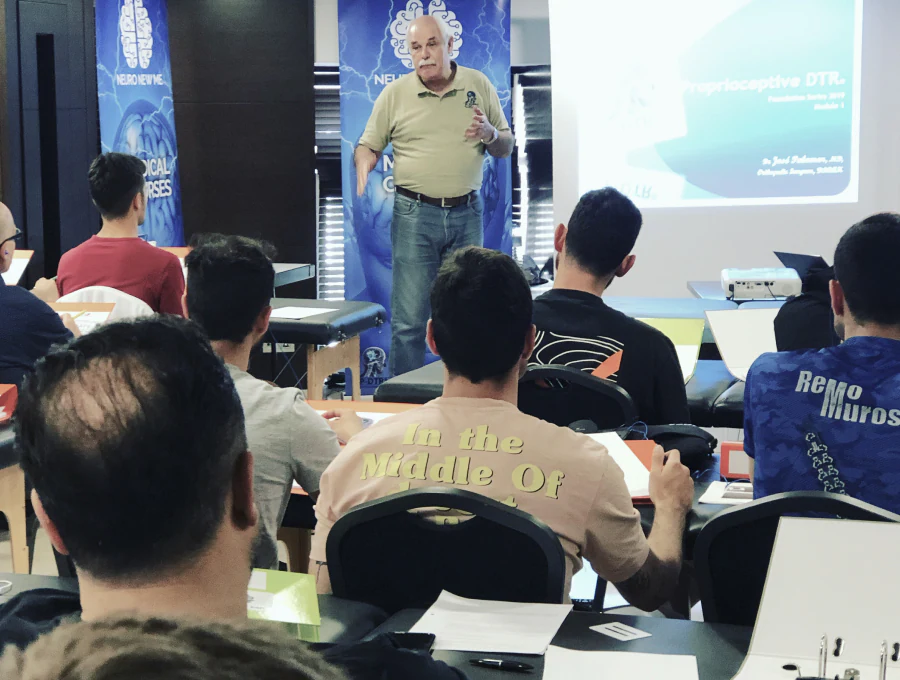
At Neuro New Me, we know how important it is to balance professional development with patient care. That is why our P-DTR courses include 2 days of online content, delivered before the 3 days of in-person training. The online part is self-paced and time zone–friendly, so you can study when it suits you best: early in the morning, after clinic or at the weekend. Module 2 builds on the Foundation basics and moves from single receptors to the structures and movement patterns that shape how the body works. You will study pressure and vibration dysfunctions (including Pacinian corpuscles and the use of tuning forks), the rules for muscles, joint capsules, cartilage, spinal ligaments, talus, hyoid, earlobes, nose and lips, and a region-by-region review of the body's ligaments, from the pelvis and hip to the shoulder, elbow and wrist. The second half focuses on gait: the types of sensory input, the role of the cerebellum, the eight gait phases, the mechanical breakdown of the stance phase, gait inhibition, the Palo Alto and Pilus patterns, pelvic categories and joint position proprioceptors. You will be able to read and correct what you see when a patient walks.
Course content
- Pressure and Vibration Dysfunctions: Pacinian Corpuscles
- Pressure and Vibration Dysfunctions: Vibratory Receptors
- Pressure and Vibration Dysfunctions: Use of Tuning Forks
- NeuroGait II
- Localization of Nerve Endings
- Rules of Muscles
- Rules of Joint Capsules and Non-Joint Capsules
- Rules of Joint Hyaline Cartilage
- Rules of Joint Fibrocartilage
- Rules of Spinal Ligaments
- Rules of Talus
- Rules of Hyoid
- Rules of Earlobes
- Rules of Nose
- Rules of Lips
- Ligament Palpation and Muscle/Ligament Relationships
- Pelvic Ligaments
- Hip Ligaments
- Knee Ligaments
- Ankle/Foot Ligaments
- Sternal and Clavicular Ligaments
- Shoulder Ligaments
- Elbow/Wrist Ligaments
- Organ Suspension Ligaments
- Rules of Bones
- NeuroGait I
- Gait: Types of Sensory Input
- Effect of Stepping Rate in Stance and Swing Phases
- Automatic Gait
- Cerebellum and Gait
- Gait Phases: Phase 1: Initial Contact
- Gait Phases: Phase 2: Loading Response
- Gait Phases: Phase 3: Mid Stance
- Gait Phases: Phase 4: Terminal Stance
- Gait Phases: Phase 5: Pre-Swing
- Gait Phases: Phase 6: Initial Swing
- Gait Phases: Phase 7: Mid Swing
- Gait Phases: Phase 8: Terminal Swing
- Gait Phases: Mechanical Breakdown of Stance Phase
- Gait Phases: Joint Ligaments and Involved Muscles
- Gait Inhibition: Background
- Gait Inhibition: Symptoms
- Gait Inhibition: Testing Procedure
- Gait Inhibition: Inhibition Patterns
- Gait Inhibition: Treatment
- Gait Inhibition: Iliolumbar Ligament
- Palo Alto: Background
- Palo Alto: Testing Procedure
- Pilus: Background
- Pilus: Symptoms
- Pilus: Testing Procedure
- Pilus: Treatment
- Pelvic Categories: Pelvic Category I
- Pelvic Categories: Topic 2
- Joint Position Proprioceptors