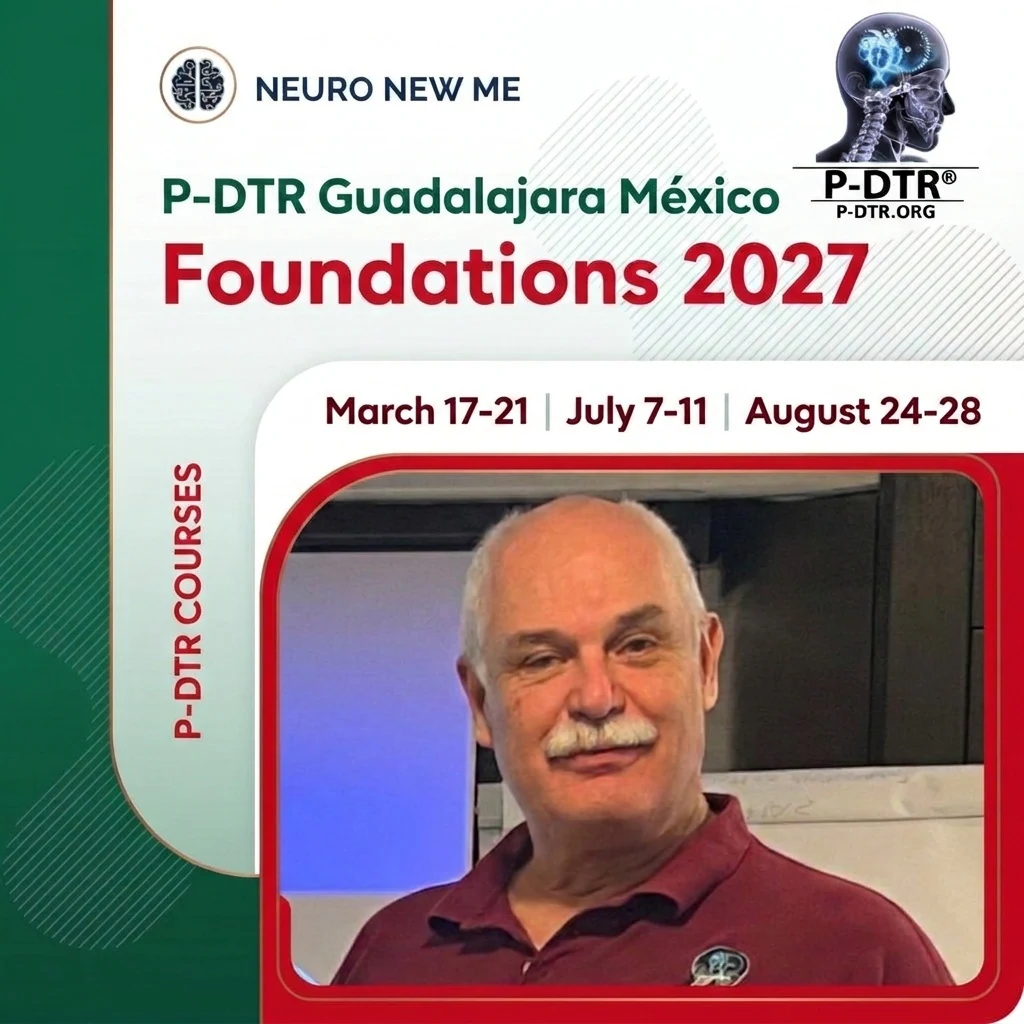
P-DTR Guadalajara México | Foundations 2027 - Todos los módulos
In person
17/03/2027 – 28/08/2027
Guadalajara, MX
€4,000.00
At Neuro New Me, we know how important it is to balance professional development with patient care. That is why our P-DTR courses include 2 days of online content, delivered before the 3 days of in-person training. The online part is self-paced and time zone–friendly, so you can study when it suits you best: early in the morning, after clinic or at the weekend. Across three progressive modules, you will build a solid base in functional neurology, pain neuroscience and P-DTR. You will understand why your patients' systems are protecting themselves rather than “failing”, and how to intervene with precision instead of chasing symptoms. You will see how hardware (joints, muscles, organs) is always driven by software (sensory input, processing and output), and how to identify and correct the disorganized inputs behind chronic pain, recurrent injuries, fatigue and performance limits. The curriculum blends clear theory with live clinical reasoning, myotatic reflex testing, practical assessment and real case applications, so each concept is tied directly to what you do in the treatment room. By the end of Foundations, you will have a structured, step-by-step way to read the nervous system as an integrated whole, detect priorities instead of compensations, and design treatments that are more effective, safer and longer-lasting, whatever your current background or technique.
Course content
Module 1
- What is P-DTR
- Concept of Neurological Health
- Learn P-DTR® Manual Muscle Testing Assessment Process
- Learn P-DTR® Approach to Treat Dysfunctions
- Understand the “Algorithmic” Rules of P-DTR®
- What does P-DTR® Treat
- Principles of P-DTR®
- Sensitivity and Sensitization
- Anatomy of a Dysfunction
- Receptor Identification
- Manual Reflex Testing Concepts
- Autogenic Inhibition
- Hypertonicity
- Neurological Switching
- Muscle Spindle Cells
- Therapy Localization
- Deep Tendon Reflex
- Wide Dynamic Range Neurons
- Assessment and Treatment
- Introduction to Nociception
- Nociceptive Dysfunctions
- Golgi Tendon Organs Dysfunctions
Module 2
- Pressure and Vibration Dysfunctions
- NeuroGait II
- Localization of Nerve Endings
- Rules of Muscles
- Rules of Joint Capsules and Non-Joint Capsules
- Rules of Joint Hyaline Cartilage
- Rules of Joint Fibrocartilage
- Rules of Spinal Ligaments
- Rules of Talus
- Rules of Hyoid
- Rules of Earlobes
- Rules of Nose
- Rules of Lips
- Study of the Ligaments of the Entire Body
- NeuroGait I
- Gait: Types of Sensory Input
- Effect of Stepping Rate in Stance and Swing Phases
- Automatic Gait
- Cerebellum and Gait
- Gait Phases
- Gait Inhibition
- Pelvic Categories
- Joint Position Proprioceptors
Module 3
- Long Kinematic Chains
- Spinothalamic Dysfunctions
- Thermal Nociception
- Tickle and Itch
- Cloacal Synchronization
- Vertebral and Limbic Fixation
- Adrenals
- Cranial Faults
- Frontal Lobe Emotions
- Meridians